Feedback that gives someone a way forward
'Be more proactive' sounds like advice. What would make it useful enough to act on?
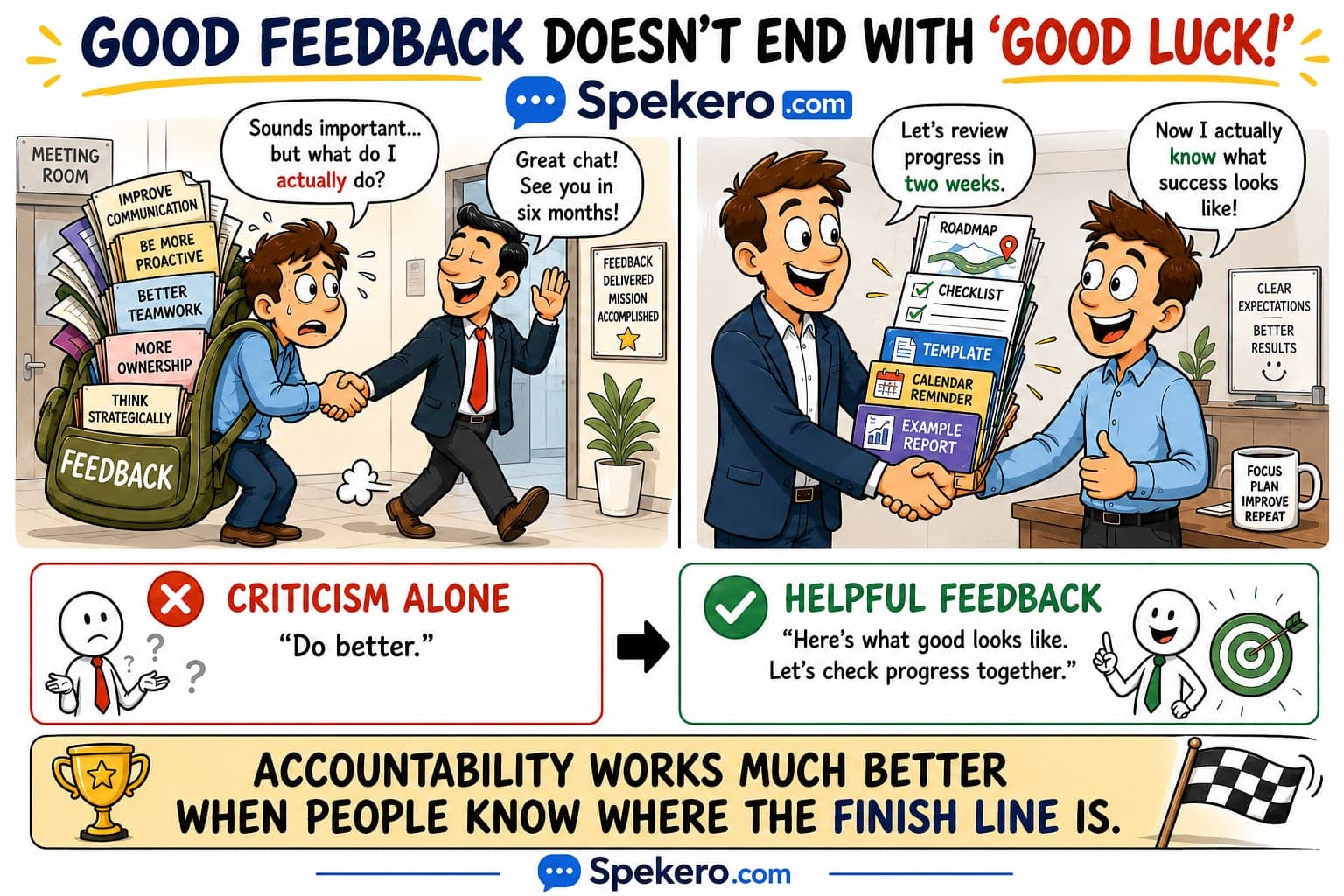
The situation
You lead a small team. A colleague's weekly updates often leave out decisions that other people need. You tell them to 'communicate better and be more proactive'. They nod, but the next update has the same problem.
They ask what you actually want them to do differently. They have not received a template or an example, and you have not checked what information they can access.
Recommended Response
A. Explain which decisions were missing, ask about obstacles, agree a short update template and arrange a realistic check-in.
This turns a vague judgement into a specific, shared plan. It also checks whether missing information or competing demands are part of the problem rather than assuming poor effort.
Context matters. This is a recommendation for the situation described, not a rule for every interaction.
Explore every response
A. Explain which decisions were missing, ask about obstacles, agree a short update template and arrange a realistic check-in. (Recommended)
This turns a vague judgement into a specific, shared plan. It also checks whether missing information or competing demands are part of the problem rather than assuming poor effort.
B. Repeat 'be more proactive' more firmly so they realise you mean it.
Firmness can clarify that a task matters, but repeating an unclear instruction does not explain what to change. The colleague still needs an observable example and workable expectations.
C. Rewrite all their updates yourself and stop discussing the issue.
Taking over may protect an urgent deadline. As a permanent response, it can hide the gap, increase your workload and deny the colleague opportunities to learn. A worked example followed by practice would be more useful.
D. Tell the team that this colleague lacks initiative so everyone can push them harder.
A public character label can embarrass someone without improving the work. Where a team process needs discussion, address the process and shared expectations rather than inviting others to pressure an individual.
Why is A the recommended response?
Make the next step visible
Useful feedback connects a specific observation to its impact and to an achievable next action. 'Communicate better' could mean earlier updates, shorter messages or clearer decisions. Unless you make the expectation concrete, the colleague has to guess which meaning you intend.
The last update did not include the approval date, so the team could not schedule the next step. Could we include the decision, owner and due date each week? What might make that difficult?
Support and accountability belong together
Ask whether the colleague has access to the decisions, enough time to gather them and a clear route for chasing missing information. This does not mean removing responsibility. It means agreeing what each person can reasonably control before judging the outcome.
A short example and a mutually understood check-in make progress easier to discuss. Allow room for questions and adjustments. The right level of support depends on experience and task complexity; constant checking can become unnecessary micromanagement.
What can we learn?
- Use a recent example, not an absolute such as 'you always fail'.
- Agree what a good result looks like and when it is needed.
- Check resources and obstacles before concluding that someone does not care.
- Review whether your own instructions were understandable and consistent.
- Recognise progress, and adjust the plan if the original expectation was unrealistic.
A deeper question to reflect on
Could someone act on your last piece of feedback without having to guess what you meant?
Key takeaway
Feedback becomes useful when the next step is clear and achievable.
Practice. Speak. Improve. — Spekero Playground